
Animal Feed Pellet Production Line Overview
Designed for large industrial animal feed pellet plants for processing various livestock and poultry feeds like chicken, pig, cattle, sheep, rabbit, etc.
The Large Ring Die Animal Feed Pellet Production Line is an advanced, high-capacity feed processing system designed for producing premium-quality pellets for livestock, poultry, and aquaculture. It is suitable for large-scale feed mills, commercial feed manufacturing companies, and large animal farms that require continuous, efficient, and automated feed production. This line adopts ring die pelletizing technology, ensuring uniform pellet size, high density, and excellent durability—ideal for meeting the nutritional needs of various animals. It includes crushing, mixing, pelletizing, cooling, screening, and packing sections.

Complete Poultry & Livestock Feed Pellet Production Line
We can customize various capacity animal feed pellet plants to meet our customers’ needs, from small feed pellet lines of 2 tons/h to large animal feed pellet plants of 20 tons/h. They are applicable for large feed factories, poultry farms, or farm use to make feed pellets for not only poultry like chicken, duck, geese, quail, but also livestock such as cattle, cows, sheep, rabbits, pigs, etc. We also supply small-scale animal feed pellet lines with capacities ranging from 600 kg/h to 2,000 kg/h, which are equipped with flat die feed pellet machines.
Advantages of Using a Feed Pellet Line
- Increases feed digestibility and conversion rate
- Reduces feed waste and storage space
- Prevents feed ingredient separation during handling
- Enhances animal growth and health
- Improves farm profitability and production efficiency
Feed Pellet Line Application Scope
- Poultry farms (chicken, duck, goose)
- Livestock farms (pigs, cattle, sheep, goat)
- Animal feed processing factories
- Commercial feed suppliers
- Agricultural cooperatives

Small Animal Feed Pellet Production Line
Adopt Flat Die Feed Pellet Machines
Capacity: 600 kg/h to 2,000 kg/h

Large Animal Feed Pellet Production Line
Adopt Ring Die Feed Pellet Machines
Capacity: 2 tons/h to 20 tons/h
CONTACT US FOR A FREE CONSULTATION
Large Animal Feed Pellet Line Video Show
Process Flow of The Animal Feed Pellet Production Line

The feed pellet production line layout is customizable. The entire feed pellet plant can be customized based on: The Feed Plant size, desired output, and available raw materials. Generally, the animal feed production includes below steps.
Raw Material Collecting Cleaning→ Grinding →Batching and Mixing → Pelletizing → Pellet Cooling → Pellet Crumbler→ Grading and Sieving → Packing

Feed Pellet Sifting Euipment

Feed Grinding Machine

Feed Conveying
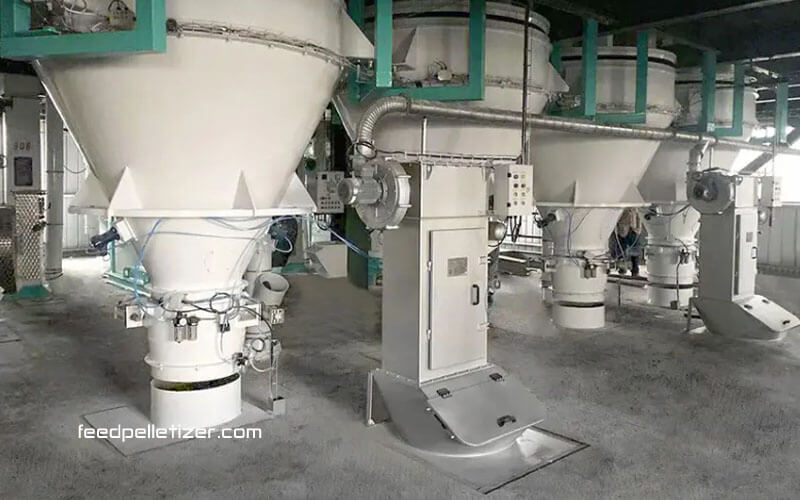
Feed Dosing Equipment
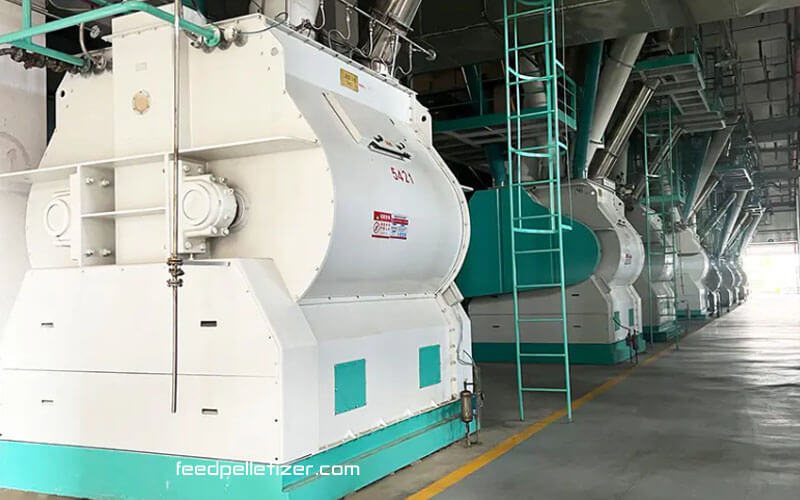
Feed Mixing Machine

Feed Pellet Machines
Feed Pellet Sifting Euipment
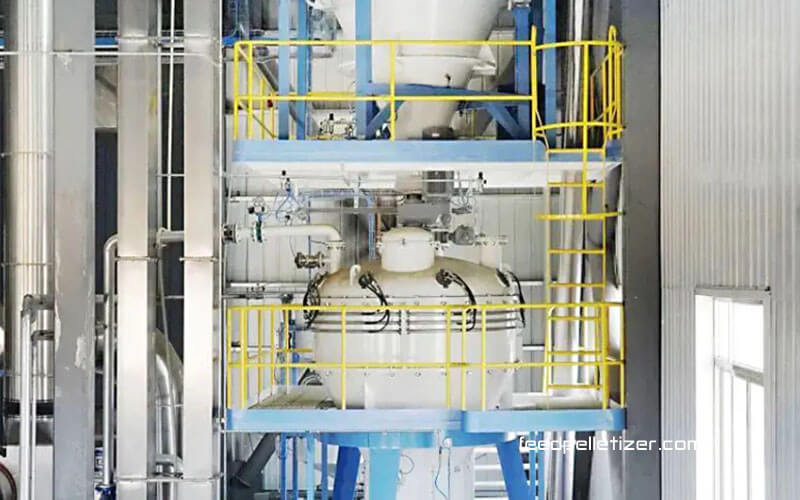
Liquid Adding Coating Equipment

Feed Pellet Drying Cooling Equipment

Feed Pellet Packing Machine
Main Equipment in the Animal Feed Pellet Production Line
1. Raw Material Grinding – Feed Hammer Mill
Function: Grind the raw materials into the required size for further processing in poultry and livestock feed pellet production.
Features: High-speed rotor, fine grinding, customizable screen size.
Machine: Feed hammer mills are adopted here to improve the production efficiency and make the high delicious poultry feed pellets. After grinding, the diameter of the final products could be 3-5mm, which is the optimal size for pelleting. Both coarse and fine grinding can be realized through adjusting the gap between hammers and the screen. The feed hammer mill is equipped with an air blower, and the crushed material can be directly collected and transported to the next machine for further processing.

2. Feed Batching and Mixing – Feed Mixer Machine
Function: Mixes different raw materials and additives evenly.
Machines: Horizontal ribbon mixer, paddle mixer, or vertical mixer. The double-shaft feed mixing machine is widely used in blending powdery materials in feed production lines to ensure compound poultry feed quality. High mixing speed. Short mixing cycle. Highly homogeneous.
Feed Batching: Feed batching is necessary in feed pellet production, which can ensure the animals receive the correct amount of nutrients and feed additives. Proper batching can improve diet uniformity and animal performance. Batching the powder feed raw materials according to the formula.

3. Animal Feed Pelletizing – Feed Pellet Machine
Function: Compresses the mixed feed into pellets. Forcing feed materials through die holes to form compacted feed pellets, which are then cut into a pre-determined size.
Machines: The type selected depends on production capacity. Flat Die feed pellet machines for small-scale animal feed pellet plants. Ring Die feed pellet machines for medium to large-scale animal feed pellet plants. Replace the pellet mill die to make poultry feed pellets with different diameters.

4. Pellet Cooling – Counterflow feed pellet cooler Machine
Function: The feed pellets that come out of the feed pellet machines are hot and soft. A pellet cooler machine is used to cool down freshly made pellets from 70–90°C to room temperature to prevent spoilage.
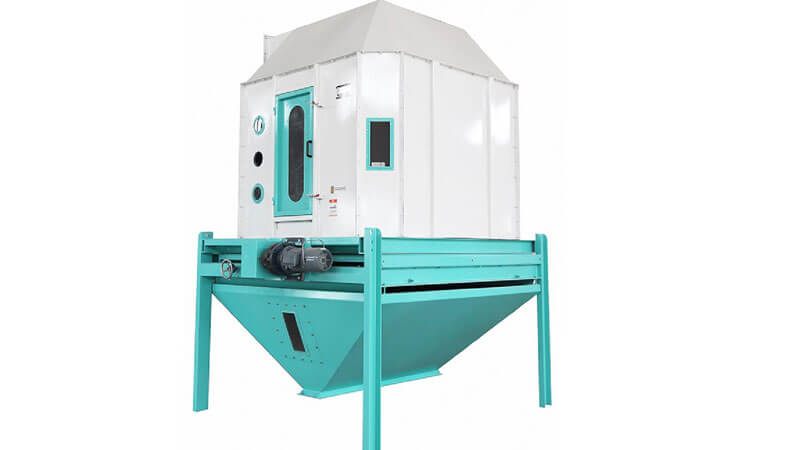
Pellet Cooling Machine: Counter-flow pellet cooler. Adopt the counter flow cooling principle to cool down pellets to avoid sudden cooling, thus preventing the surface cracking of feed pellets. The octagonal cooling chamber design ensures no dead angle. Low energy consumption and easy operation.
5. Pellet Crumbler (Optional) – Feed Pellet Crumbler Machine
Function: Breaks large pellets into smaller sizes for baby animals. The large feed pellets can be crushed into different particles in a certain range, which has a direct impact on both the cost and the nutrition of feed pellets.
Feed Pellet Crumbler Machine: The feed pellet Crumbler machine is used for crushing feed pellets of various sizes to 0.6-1.5mm or 1-2.5mm to feed the small animals. Compact structure, uniform reduced particle size, and convenient particle size adjustment. Unique feeding hopper and bypass ancillary equipment. Smooth transmission, low noise, reliable running, and easy operation.

6. Grading and Sieving – Feed Pellet Vibrating Sieve
Function: Removes powder and unqualified pellets. Ensures pellet size uniformity. The crushed feed pellets are in different sizes, and there may be some powders contained. The rotary sieve is designed for sifting and classifying the pellet feed. After processing, you can get the qualified feed pellets without fine powder.
Feed Pellet Vibrating Sieve: Small vibration, low noise, high sieving effect. Both two-layer screen frames and three-layer frame designs are available. Integrated screen frame structure, lightweight, high rigidity, and good sealing.

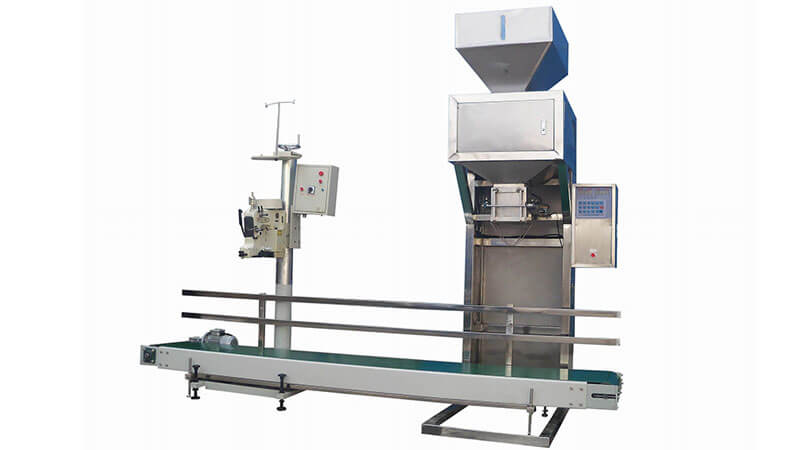
7. Feed Pellet Packing – Automatic Pellet Packing Machine
Function: Weighs and packs finished pellets into bags for easy transport and storage. Automatic pellet weighing and packing machines play an indispensable role in large feed pellet production lines.
Machines Options: Manual, semi-automatic, or automatic packing systems.
8. Optional Features and Add-ons
Dust collection system – for cleaner operation
Steam conditioning unit – for ring die machines
Liquid spraying system – to add molasses, oil, or other nutrients
Fully automatic control system – PLC for intelligent automation

Feed Pellet Production Line Applications
Suitable Raw Materials
- Corn, wheat, rice, and other grains
- Soybean meal, cottonseed meal, fish meal
- Bran, grass powder, alfalfa, molasses
- Premixes (vitamins, minerals, amino acids)
- Additives and binders
Feed Pellet Sizes and Types
- 2–3 mm: Suitable for Chicks, piglets, rabbits
- 4–5 mm: Suitable for Chicken, ducks, sheep
- 6–8 mm: Suitable for Pigs, cattle, goats, and horses
- Custom pellet sizes are available based on the die in the pellet machines.

CONTACT US FOR A FREE CONSULTATION
Benefits of Making Animal Feed Pellets
The benefits of making poultry and livestock feed pellets, especially when using a feed pellet production line
1. Improved Feed Digestibility. Pelletizing breaks down raw materials, reduces anti-nutritional factors, and increases the bioavailability of nutrients. This enhances feed digestion and absorption in poultry and livestock.
2. Reduced Feed Wastage. Feed Pellets are denser and more uniform than mash or powder feed, which means less feed gets blown away or spilled. Animals are less likely to sort or reject ingredients.
3. Enhanced Palatability. Feed pellets are easier for animals to consume and chew. The heat and pressure during pelletizing can improve taste, reduce bitterness, and eliminate unpleasant odors in certain ingredients.
4. Improved Feed Handling and Storage. Less dust, easier transportation. More compact, saving storage space. Longer shelf life due to lower moisture and better microbial stability
5. Balanced Nutrition in Every Bite. Feed Pellets provide uniform nutrition in each piece, ensuring animals get a consistent intake of essential nutrients, vitamins, and minerals in every mouthful.
6. Higher Feed Conversion Rate (FCR). Animals fed with pellets usually convert feed to body weight more efficiently than those fed with unprocessed mash feed, resulting in faster growth and higher productivity.
7. Sterilization Effect. The high temperature during pelletizing kills bacteria, mold, parasites, and pathogens, reducing the risk of disease transmission through feed.
8. Customized Feed Formulas. Pellet machines allow farmers to use different formulas tailored for the Age and weight of animals, specific animal species (chicken, pig, cattle, sheep, etc.), and special feeding needs (growth, reproduction, fattening, etc.).
9. Lower Cost Over Time. While the initial investment in pellet machines and production lines is higher, the long-term benefits are better. All contribute to higher profits.


