
Electric Flat Die Feed Pellet Machine Overview
The Electric Flat Die Feed Pellet Machine is a compact, efficient, and easy-to-operate machine used to make animal feed pellets from powdered feed ingredients. Powered by an electric motor, it uses a flat die and rotating roller system to compress mixed feed materials into cylindrical pellets. With capacities ranging from 180kg/h to 2,000 kg/h, this type of animal feed pellet machine is widely used by small and medium-scale livestock or poultry farms, animal feed mills, farmers, home feed producers, and small feed pellet plants.
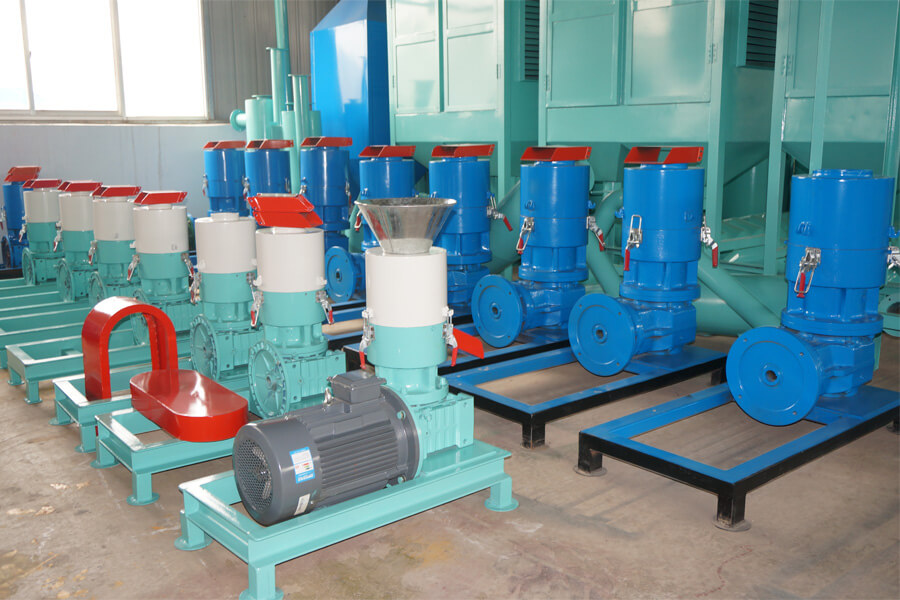
Flat Die Feed Pellet Machine Models and Parameters
| Model | Power(kw) | Capacity(kg/h) | Dimension(m) | Wight(kg) |
|---|---|---|---|---|
| SK200 | 7.5 | 180-200 | 1.15*0.53*0.75 | 320 |
| SK250 | 15 | 250-300 | 1.35*0.65*1.15 | 500 |
| SK300 | 22 | 300-500 | 1.55*0.65*1.3 | 680 |
| HK250 | 22+1.5+0.55 | 600-800 | 1.6*1.5*1.55 | 1,200 |
| HK260 | 22+1.5+0.55 | 800-1,000 | 1.6*1.5*1.55 | 1,500 |
| HK300 | 30+1.5+0.55 | 1,500-2,000 | 1.65*1.5*1.55 | 1,800 |

Small Animal Feed Pellet Line
CONTACT US FOR A QUOTE
How The Flat Die Feed Pellet Machine Works
This Small Feed Pellet Machine uses a flat die with holes and compression rollers that rotate over the die to force feed material through the holes. The extruded feed comes out in cylindrical form and is cut by knives at the desired length.
Flat Die Feed Pellet Machine Process Flow:
- Raw materials (corn, soybean meal, wheat bran, etc.) are ground and mixed.
- The mixture is fed into the hopper.
- Rollers press the material through the flat die.
- Pellets are extruded and cut to length.
- Pellets fall out through the outlet for cooling and packing.

Key Components
- Electric Motor: Provides consistent and clean power.
- Flat Die: Steel plate with evenly spaced holes for forming pellets.
- Rollers: Press feed through the die under high pressure.
- Feeding Hopper: Where raw materials are loaded.
- Pellet Cutter: Adjusts the length of finished pellets.
- Frame and Base: Ensures stability and vibration reduction.
Feed Material Requirements
- Moisture content: 12%–15%
- Well-mixed powder (crushed using a hammer mill)
- Optional additives (vitamins, minerals, oil) can be added during mixing
Maintenance Tips
- Regularly lubricate the roller and bearings.
- Clean die holes after each use to prevent blockage.
- Replace the flat die after 500–1000 hours (depending on usage).
Comparison: Flat Die vs Ring Die Pellet Machine
| Feature | Flat Die Pellet Machine | Ring Die Pellet Machine |
|---|---|---|
| Size | Compact | Large-scale |
| Cost | Low | High |
| Output | 0.18 to 2 tons/h | 1.5–20 tons/h |
| Power Requirement | 7.5 – 32 kw | 37 – 132 kw |
| Maintenance | Simple | Complex |
| Ideal for | Farms, small feed plants | Industrial Feed Production |


Electric Flat Die Feed Pellet Machine Features and Benefits
✔ Compact & Easy to Operate. Simple design, ideal for on-farm or home use. Requires minimal training to run.
✔ Energy Efficient. Powered by electricity. No fuel, smoke, or noise pollution.
✔ Versatile Pellet Sizes. Adjustable die holes (typically 2.5–8 mm) to suit various animals. Poultry: 3 mm, Pigs: 4 mm, Cattle: 6–8 mm, Fish: 2.5 mm
✔ Durable and Long-Lasting. High-carbon steel rollers and dies. Easy to replace wearing parts like dies and bearings.
✔ Low Investment. Affordable for startups and smallholders. Quick return on investment by making your own feed.
✔ Wide Applications. The electric flat die feed pellet machine is suitable for producing feed pellets for Chickens, Ducks, Geese, Rabbits, Cattle, Sheep, Pigs, Fish (with an appropriate fine die)
