

Dry Type Fish Feed Extruder Machine Overview
The Dry Type Fish Feed Extruder is a cost-effective machine used to produce floating and sinking aquatic feed pellets without the need for steam or additional conditioning equipment. It is widely used in small to medium fish farms and feed processing businesses to make high-quality fish feed from raw materials such as corn, soybean meal, rice bran, fish meal, and wheat. Fish feed extruders come in two main types:
- Dry-type fish feed extruder (capacity 60 kg/h to 2,000 kg/h) – No need for a steam boiler, suitable for small-scale feed plants.
- Wet-type fish feed extruder (capacity 200 kg/h to 5,000 kg/h)– Requires a steam boiler; produces higher quality and more uniform pellets, ideal for large-scale production.
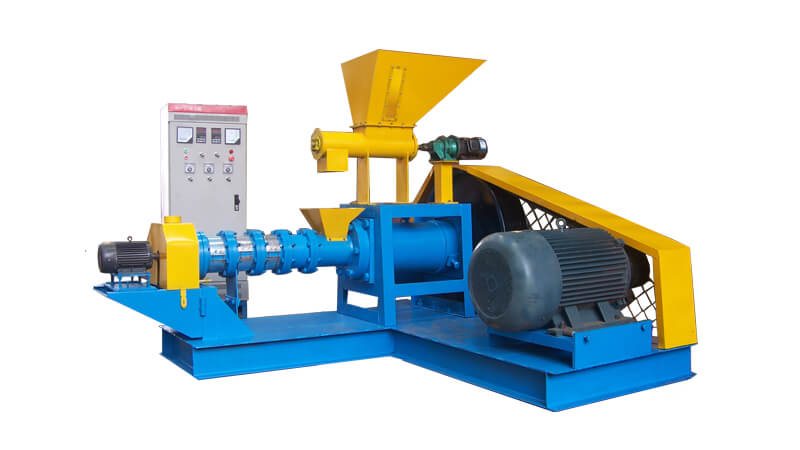
Dry Type Fish Feed Extruder Machine

We supply both dry-type fish feed extruders and wet-type fish feed extruders to meet your fish feed production needs. If you have fish ponds or small aquatic farms, this dry-type fish feed extruder machine is a cost-effective choice to make your own fish feed pellets instead of buying feed. With a simple design and easy operation, it can help you make good-quality floating feed pellets for all kinds of fish, shrimp, crab, etc. Besides, just change the different dies and you can make feed pellets in various sizes, wonderful taste, and an attractive color.
- Packaging: Wooden case packing, one 40ft container can contain 5 sets
- Delivery: Within 30 days after receiving the deposit
- Voltage: 380V, 50HZ, 3phase Customizable.
Dry-type Fish Feed Pellet Extruder Machine Models
|
Model
|
Capacity
|
Main power
|
Feeding power
|
Screw diameter
|
Cutting power
|
|
DGP50
|
0.06-0.08t/h
|
11kw
|
0.4kw
|
φ50mm
|
0.4kw
|
|
DGP60
|
0.12-0.15t/h
|
15kw
|
0.4kw
|
φ60mm
|
0.4kw
|
|
DGP70
|
0.18-0.25t/h
|
18.5kw
|
0.4kw
|
φ70mm
|
0.4kw
|
|
DGP80
|
0.3-0.35t/h
|
22kw
|
0.4kw
|
φ80mm
|
0.6kw
|
|
DGP90
|
0.4-0.45t/h
|
37kw
|
0.4kw
|
φ90mm
|
1.5kw
|
|
DGP120
|
0.5-0.7t/h
|
55kw
|
0.4kw
|
φ120mm
|
2.2kw
|
|
DGP135
|
0.8-1.0t/h
|
75kw
|
0.4kw
|
φ133mm
|
2.2kw
|
|
DGP160
|
1.2-1.5t/h
|
90kw
|
0.75-1.1kw
|
φ155mm
|
3.0kw
|
|
DGP200
|
1.8-2.0t/h
|
132kw
|
1.5kw
|
φ195mm
|
3.0-4.0kw
|
CONTACT US FOR A QUOTE
Comparison: Dry-type Fish Feed Extruder vs Wet-type Fish Feed Extruder
| Feature | Dry-type Fish Feed Extruder | Wet-type Fish Feed Extruder |
|---|---|---|
| Steam Requirement | ❌ No steam required | ✅ Requires steam (needs boiler) |
| Conditioner Needed | ❌ Not required | ✅ Required |
| Initial Investment | 💲 Lower cost | 💲💲 Higher cost (due to boiler and steam system) |
| Pellet Quality | Good for basic floating and sinking feed | Better pellet quality and gelatinization (high nutritional value) |
| Capacity Range | Suitable for small to medium production (60–2,000 kg/h) |
Suitable for medium to large-scale production (200 – 5,000 kg/h) |
| Cooking & Gelatinization | Relies on mechanical friction and heat | Uses steam for better cooking and starch gelatinization |
| Pellet Types | Floating & sinking pellets, pet food | Floating, slow-sinking, and sinking pellets |
| Final Pellet Appearance | Slightly rougher texture | Smoother, more uniform pellets |
| Operation | Easier to operate and maintain | Requires trained operators and more care |
| Footprint | Compact, portable | Larger, requires more space |
| Applications | Small fish farms, home production, rural areas | Commercial aquaculture, feed mills, industrial use |
Choose Dry-type Fish Feed Extruder if:
- You are just starting or have a small to medium-sized fish farm.
- You want a low-cost, simple, and mobile solution.
- You don’t have access to a steam boiler or high-power supply.
- You’re producing feed for tilapia, catfish, or ornamental fish.
Choose Wet-type Fish Feed Extruder if:
- You have a large-scale operation or commercial feed factory.
- You need higher-quality fish pellets with better nutrient absorption.
- You can afford the higher initial investment and have access to steam.
- You’re producing feed for shrimp, eels, salmon, or high-value fish.


Dry Type Fish Feed Extruder Machine Advantages
- Lower equipment cost: No need for a boiler or conditioner
- Compact size: Fits easily in small workshops or farms
- Energy-efficient: Consumes less power than wet extruders
- Multi-use: Can make feed for aquatic animals and pets
- Portable: Can be mounted on wheels for easy movement
For a complete small-scale feed production line:
Feed Mixer → Crusher (Hammer Mill) → Dry Extruder → Dryer → Pellet Cooler → Packing Machine

Dry Type Fish Feed Extruder Application
- Fish (catfish, tilapia, carp, trout, etc.)
- Shrimp, crab, and other aquatic animals
- Pet food (dogs, cats, birds, etc.) with formulation changes
- Can also be used for small poultry or livestock feed
Dry Type Fish Feed Extruder Ideal Users
- Small-scale fish farmers
- Local aquaculture cooperatives
- Entrepreneurs entering the feed business
- Educational and research institutes

Dry Type Fish Feed Extruder Working Principle
- Raw materials are fed into the extruder’s hopper.
- A screw shaft inside the barrel drives the mixture forward, generating frictional heat that cooks the material.
- The material is compressed and expanded as it exits through the die mold.
- A rotary cutter slices the extruded feed into uniform pellets.
- The pellets puff due to sudden pressure release at the outlet.
- Unlike wet extruders, no boiler or steam is required — the cooking is achieved solely through mechanical friction and pressure.
Dry Type Fish Feed Extruder Key Components
- Feeding hopper
- Extrusion chamber (includes screw, barrel)
- Heating section
- Die mold
- Rotating cutter
- Discharge outlet
- Control panel
Dry Type Fish Feed Extruder Features
- No need for a steam boiler. Easy installation and lower operation cost
- Suitable for making floating and sinking feed. This dry-type fish feed pelletizer can produce all floating, sinking, and slow-sinking aqua-feed pellets just by adjusting feed formulation and degree of expansion.
- Wide range of pellet sizes: 0.9mm to 15mm. Different molds can be chosen to make fish feed pellets with different diameters and shapes.
- The auto-temperature control system ensures continuous operation with automatic temperature precision control. An electric heating device is adopted to improve the feed expansion rate and fish feed pellets’ floating time.
- Easy to operate and maintain. Heavy-duty structure. Wear-resistant alloy steel screw and barrel.
- Can process a variety of ingredients, including corn, wheat bran, fish meal, and soybean meal. High temperature and high pressure processes can kill salmonellosis and bacterial infections in materials and also make the pellets easier to digest and absorb.

The Benefits of Puffed Fish Feed Pellets
Most fish feed pellet includes animal protein and plant protein: plant protein adopts corn flour, rice flour, wheat flour, soybean flour, peanut cake powder, and animal protein adopts fish meal, shrimp meal, crab meal, sleeve-fish meal, and so on. You can add other ingredients according to the local fish’s life requirements.
Note: We can provide a free formula.
1. Improved Digestibility and Nutritional Value. From the fish feed extruder, feed pellets are in a “popcorn” state, not only physical state changed, but also the shape and internal structure of organic molecules have been changed, which makes feed pellets easier to digest and absorb for fish.
2. High Feed Conversion Ratio (FCR). After treatment of puffing, the fragrance and palatability of the feed have been improved to stimulate the appetite of the animal. Puffed pellets offer better palatability and digestibility, improving the FCR and overall growth performance.
3. High temperature and high pressure process can kill the salmonellosis and bacterial infections and make the pellets Hygeian for fish.
4. The puffed fish feed pellets can float on the water surface without dissolution for over 12 hours, reducing feed waste and keeping the water quality. Floating feed minimizes feed residue at the pond bottom. Better feed conversion means less uneaten feed, reducing ammonia and nitrogen buildup in water.
5. Customizable Formulation. Ingredients can be precisely blended to suit different species and growth stages. Vitamins, minerals, amino acids, probiotics, and medicines can be easily added.
6. Longer Shelf Life. Better Handling and Storage. Low moisture content (<10%) in puffed feed pellets ensures better preservation and a lower risk of mold or spoilage during storage.
