

Wet Type Floating Fish Feed Extruder Machine
Commonly used in commercial fish feed production for making high-quality floating or sinking fish feed pellets
The wet-type fish feed extruder is a specialized machine used to produce floating or sinking aquatic feed pellets for fish, shrimp, crabs, and other aquatic species. Unlike the dry type fish feed extruder, the wet type fish feed machine is equipped with a boiler or steam conditioner that preconditions the raw materials with steam and moisture before extrusion. This results in more stable, uniform, and nutritionally dense feed pellets. The wet-type floating fish feed machine can produce better-quality fish feed in a larger fish feed plant compared with the dry-type fish feed machine. The output capacity ranges from 200 kg/h to 5,000 kg/h. It is not only suitable for making high-grade aquatic feed pellets for fish, catfish, shrimps, crab, etc, but also ideal for making pet food for dogs, cats, etc.
Fish feed extruders come in two main types:
- Dry-type fish feed extruder (capacity 60 kg/h to 2,000 kg/h) – No need for a steam boiler, suitable for small-scale feed plants.
- Wet-type fish feed extruder (capacity 200 kg/h to 5,000 kg/h)– Requires a steam boiler; produces higher quality and more uniform pellets, ideal for large-scale production.
We supply both dry-type fish feed extruders and wet-type fish feed extruders to meet your fish feed production needs, and complete floating fish feed production lines.

Wet Type Floating Fish Feed Extruder Machine Models
|
Model
|
Capacity
|
Main Power
|
Feeding Power
|
Screw Diameter
|
Cutter Power
|
Conditioner Power
|
|
DSP60
|
0.18-0.20t/h
|
15kw
|
0.4kw
|
60mm
|
0.4kw
|
0.37kw
|
|
DSP70
|
0.30-0.35t/h
|
18.5kw
|
0.75kw
|
70mm
|
0.4kw
|
1.1-1.5kw
|
|
DSP80
|
0.40-0.45t/h
|
22kw
|
0.75kw
|
80mm
|
1.5 kw
|
1.5-2.2kw
|
|
DSP90
|
0.50-0.55t/h
|
37kw
|
1.1kw
|
90mm
|
2.2kw
|
2.2-3.0kw
|
|
DSP120
|
0.7-0.8 t/h
|
55kw
|
1.1kw
|
120mm
|
2.2kw
|
2.2-3.0 kw
|
|
DSP135
|
1.0-1.2t/h
|
75kw
|
1.5kw
|
135mm
|
3.0kw
|
3.0-4.0kw
|
|
DSP160
|
1.8-2.0t/h
|
90kw
|
2.2kw
|
155mm
|
3.0kw
|
4.0kw
|
|
DSP200
|
3.0-5.0t/h
|
132kw
|
2.2kw
|
195mm
|
4.0kw
|
5.5kw
|
Applications Scapes
- Commercial fish farms
- Aquaculture feed manufacturers
- Shrimp/crab hatcheries
- Pet food production (with formula change)
Requirements
- Must be connected to a steam boiler system.
- Requires trained personnel for setup and maintenance.
- Higher initial investment than dry type, but better results for commercial operations.


CONTACT US FOR A QUOTE
Wet Type Floating Fish Feed Extruder Advantages
- Produces premium-quality floating feed with uniform shape and size.
- Ideal for medium and large-scale fish farms or feed mills.
- Improves feed digestibility and nutrient absorption.
- Reduces feed waste and water pollution.
- Adjustable parameters to suit different species and growth stages.
Comparison: Wet-type Fish Feed Extruder vs Dry-type Fish Feed Extruder
| Feature | Wet-Type Fish Feed Extruder | Dry-Type Fish Feed Extruder |
|---|---|---|
| Steam Boiler | Required (external steam source needed) | Not required |
| Conditioning | Uses steam for pre-conditioning feed, improving gelatinization |
Uses mechanical heat and friction only |
| Pellet Quality | Higher gelatinization, better nutritional absorption, smoother surface |
Good quality but slightly lower than wet type |
| Capacity | Higher (suitable for industrial/commercial production) |
Lower (ideal for small/medium scale production) |
| Feed Type | Suitable for both floating and sinking fish feed pellets |
Mostly used for floating fish feed |
| Cost | Higher initial investment Due to the steam boiler and larger structure |
Lower cost and compact design |
| Moisture Control | Better moisture control with steam | Moisture control depends on the raw materials and extrusion temperature |
| Application | Large-scale aquaculture farms and fish feed plants |
Small farms, labs, startups, and rural use |
| Pre-treatment Required | Yes, with steam conditioning | No need for external pre-treatment |
| Operation Complexity | More complex; trained operators required |
Easier to operate and maintain |
Choose Wet-type Fish Feed Extruder if:
- You have a large-scale operation or commercial feed factory.
- You need higher-quality fish pellets with better nutrient absorption.
- You can afford the higher initial investment and have access to steam.
- You’re producing feed for shrimp, eels, salmon, or high-value fish.
Choose Dry-type Fish Feed Extruder if:
- You are just starting or have a small to medium-sized fish farm.
- You want a low-cost, simple, and mobile solution.
- You don’t have access to a steam boiler or high-power supply.
- You’re producing feed for tilapia, catfish, or ornamental fish.

Wet Type Fish Feed Extruder Machine
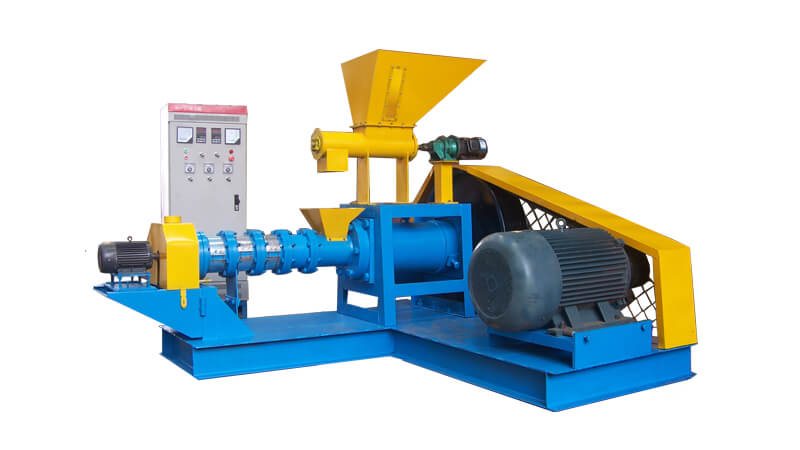
Wet Type Fish Feed Extruder Components
- Feeding System – Controls the input of raw materials into the conditioner.
- Conditioning System (Steam Conditioner) – Uses steam to preheat and hydrate ingredients for better plasticity and gelatinization.
● Upper single barrel conditioner ensures rational rotating speed and full mixing of water, steam, and raw materials.
● Lower-layer cylinder conditioner (different diameters) controls the raw materials’ fullness and conditioning time by adjusting paddles, to ensure even and full conditioning. - Extrusion Chamber (Screw + Barrel) – Compresses, heats, and shapes the feed under high pressure and temperature. The screw sleeve features a jacketed construction, allowing for the injection of hot steam or cool water to effectively control the extruding temperature.
- Cutting System – Adjustable blades that control pellet length and shape.
- Main Motor – Powers the entire machine.
- Control Panel – Controls temperature, feed rate, motor speed, and more.
- Steam Boiler – An External device to supply the required steam (usually not built into the machine and must be purchased separately).
Optional Supporting Equipment in Floating Fish Feed Plants
Raw material crusher (hammer mill)
Feed mixer
Steam boiler
Conveyor belts
Pellet dryer and cooler
Packaging machine

CONTACT US FOR A QUOTE
Wet Type Fish Feed Pellet Machine Features
- Produces high-quality floating fish feed pellets with excellent water stability. An electric heating device is adopted to improve the feed expansion rate and pellets’ floating time. The floating fish feed pellets can float on the water surface without dissolution for over 12 hours.
- Pellet size range: 0.5mm to 15mm. Suitable for fry to adult fish. You can change different molds to make fish feed pellets with different diameters.
- Better gelatinization of starch and protein due to steam pre-conditioning, improving digestibility. With the boiler continuously providing hot steam into the conditioner, materials can be fully cooked, and the nutritional value is improved, thus the quality and quantity of feed pellets can be improved greatly with lower power consumption.
- Longer life span of machine parts due to lower friction than the dry type fish feed machines. The key parts are processed through vacuum quench treatment with high processing precision.
- Supports flexible feed formulation – rice bran, soybean meal, fish meal, corn, wheat, oil, vitamin premixes, etc. Variable configurations of screw bolts can match the production demands for different formulas and raw materials.
Wet Type Fish Feed Extruder Working Principle
1. Raw Material Preparation. Before extrusion, the raw materials such as corn flour, soybean meal, wheat bran, fish meal, bone meal, vitamins, and other additives are crushed and mixed thoroughly to form a uniform feed mixture.
2. Steam Conditioning (Pre-Conditioning). This is a defining feature of the wet-type extruder. The feed mixture is first sent into a steam conditioner, where high-temperature steam (from an external boiler) is injected. The steam preheats and hydrates the feed materials, causing partial gelatinization of starch and softening of proteins. This step improves plasticity, digestibility, and binding of the final pellets.
3. Extrusion in the Screw Barrel. After conditioning, the material enters the extrusion chamber, which contains a rotating screw shaft inside a tightly fitting barrel. The screw conveys the feed mix forward, and the pressure, shear, and heat increase as the feed progresses. This causes further gelatinization, protein denaturation, and microbial sterilization.
4. Pellet Shaping and Cutting. The material is forced through a die with small holes (customizable for different pellet sizes: 0.5–15mm). As the soft pellets exit, they are immediately cut by a rotating knife to the desired length. The sudden drop in pressure causes expansion and puffing, which creates floating pellets with a porous structure.
5. Cooling and Drying. The hot and moist pellets are carried to a cooler and dryer, which reduces the temperature and moisture content. Proper cooling ensures pellet hardness and stability during packaging and storage.
6. Pellet Coating and Packing. Pellets can optionally be coated with oil, attractants, or vitamins. They are then screened and packed for distribution.

