

Animal Feed Pellet Cooler Machine Overview
The Animal Feed Pellet Cooler Machine is used to cool down hot, freshly extruded feed pellets (typically 70–90°C) to near ambient temperature (within 5–10°C difference). This feed pellet cooling process prevents pellet deformation and moisture condensation, improves storage stability, and enhances pellet durability and hardness. It is very important to improve feed pellet quality. Our counterflow pellet cooler features a significant cooling effect, excellent quality. Capacity is 3 tons/h to 20tons/h. It is the must-have equipment in large animal feed pellet plants.
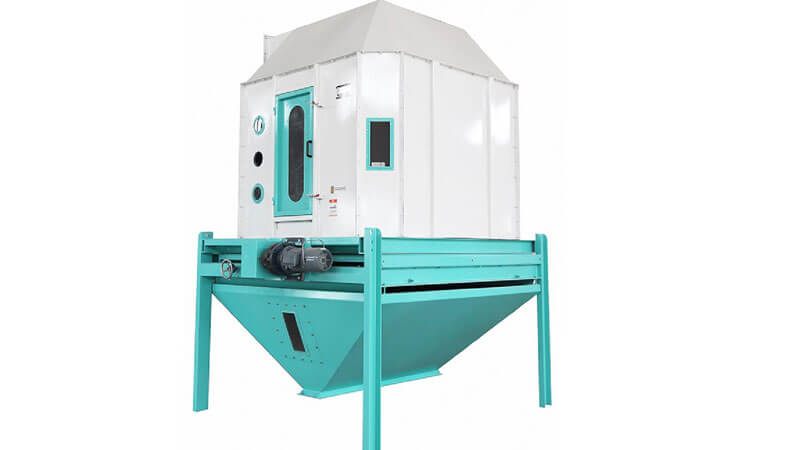
Parameter Data of the Feed Pellet Cooler
|
Model
|
SKLN1.5
|
SKLN2.5
|
SKLN4
|
SKLN6
|
SKLN8
|
|
|
Volume
|
1.5
|
2.5
|
4
|
6
|
8
|
|
|
Capacity
|
3t/h
|
5t/h
|
10t/h
|
15t/h
|
20t/h
|
|
|
Cooling time
|
not less than 6-10min
|
|||||
|
End temperature
|
not more than 3-5℃ above the room temperature
|
|||||
|
Power
|
0.75kw
|
0.75kw
|
1.5kw
|
1.5kw
|
1.5kw
|
|

Feed Pellet Cooler Machine Dimension
|
Feed Pellet Cooler
|
A
|
B
|
C
|
D
|
E
|
|
SKLN1.5
|
2630
|
1330
|
2010
|
1000
|
100
|
|
SKLN2.5
|
2800
|
1650
|
2330
|
1000
|
110
|
|
SKLN4
|
3200
|
2140
|
2570
|
1500
|
200
|
|
SKLN6
|
3460
|
2460
|
3055
|
1700
|
250
|
|
SKLN8
|
3690
|
2610
|
3290
|
1900
|
300
|
Feed Pellet Cooler Video Show – Structure and Working Principle
CONTACT US FOR A QUOTE
Feed Pellet Cooler Machine Working Principle
Feed Pellet Cooler Machine Main Components
The most important parts of the counterflow pellet cooler are: the rotary distributor, the cooling chamber, and the pendulum discharger.
The cooler typically works using the counter-flow principle.
- Hot pellets enter from the top.
- Cool air flows from the bottom and moves upward.
- This reverse airflow ensures gradual, even cooling and prevents cracking.

- Rotary Distributor: With the rotary distributor, the pellets can be cooled evenly in the bin room. Using the pendulum discharger, smooth and gentle discharge can be achieved.
- Cooling Chamber: Holds and exposes pellets to airflow. The cooling process applies the counter-flow cooling principle. Cooling air reverses the pellets, and the pellet is cooled from the bottom to the top gradually.
- Pendulum Discharger: Mechanical discharger with adjustable pellet release. The Pendulum Discharger adopts reciprocating discharge, stable operation, and small residual.
- Air Lock System: Prevents air leakage and material buildup.
- Fan and Cyclone: Provides air suction and removes fine dust.
- Sensors & Controls: Automatically regulate discharge timing and temperature.
Our Feed Pellet Cooler Machine Features
- Counter-flow cooling: Efficient and uniform feed pellet cooling, preventing the pellet appearance generating crazings.
- Discharge gate: Slide valve with variable frequency control for stable operation, with little residual.
- Anti-cracking design: Reduces thermal shock and pellet breakage.
- Dust collection system: Ensures clean operation and improves air quality. Easy operation and cleaning, high production efficiency.
- Optional sensors: Temperature and level sensors for automatic operation.
- Good construction: The octagon design cooling tank ensures the cooling has no dead angles. Adopt an air-closed material feeder, a large inlet air area. Outstanding cooling effect.

Why Cooling is Critical in Feed Pellet Production
- Reduces internal moisture in pellets, avoiding mold during storage.
- Improves hardness and durability, reducing breakage during packaging and transport.
- Prevents condensation inside packaging.
- Prepares pellets for downstream processes like screening and packing.


